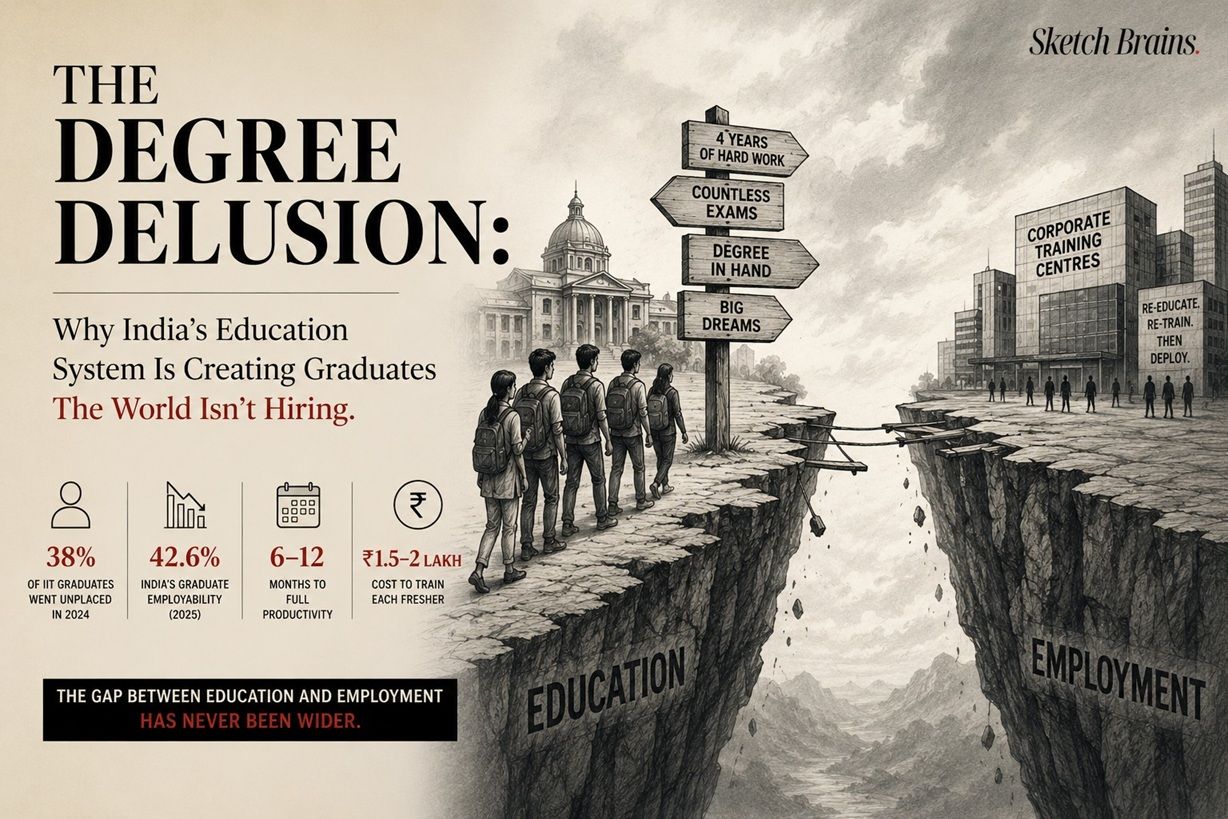
In 2024, out of 21,500 students who registered for placements across IITs, only 13,410 secured jobs - leaving 38% still searching.
Let that land for a moment.
These are not students from struggling tier-3 colleges with limited resources. These are students who cleared one of the world's most competitive entrance exams. Who spent four years in some of India's most rigorous academic programmes. Who were told, repeatedly, that the degree was the destination.
From 2022 to 2024, the number of unplaced students at older IITs rose 2.1 times. At newer IITs, it rose 3.8 times.
If this is the picture for the top 1% of engineering graduates in India, what is happening at the other 40,000 colleges across the country?
The number most people don't see
India's graduate employability currently stands at 42.6%.
Not 80%. Not 60%. 42.6%.
That's from Mercer Mettl's India Graduate Skill Index 2025 - based on data from over 2,700 campuses and more than one million students. It fell from 44.3% the year before.
More than half of Indian graduates are not industry-ready. And the gap isn't primarily in technical skills anymore. The sharpest decline is in non-technical roles - employability for HR roles dropped to 39.9%, and digital marketing to 41% - the very competencies four years of campus life should have built.
Meanwhile, Tier 3 colleges - which produce the majority of India's engineering graduates - show the lowest employability at 43.4%.
The dream that no longer leads where it used to
For decades, India ran on one roadmap:
Study hard → Crack JEE → Get a degree → Get a high-paying job.
Millions still follow it. And millions are quietly discovering it no longer leads where it used to.
Here's what happens at the end of that road:
Thousands of graduates enter the job market after years of writing assignments, memorizing concepts, and completing projects designed to score marks - not to solve problems. Then they walk into an interview and hear:
"What have you actually built? Can you walk me through how you'd handle this? How do you work under pressure with an unclear brief?"
And four years of education collapse into a single line on a resume.
Because companies aren't paying for degrees anymore. They're paying for people who can contribute from week one.
The hidden infrastructure nobody talks about
Here's the part that doesn't make it into convocation speeches:
India's largest IT companies have quietly built an entire layer of infrastructure just to bridge the gap between what colleges produce and what the workplace actually needs.
Infosys runs one of India's largest corporate training campuses - in Mysore - where freshers spend months being re-educated before touching real work. Wipro runs a structured programme called "Velocity." TCS does the same, at scale, every year.
These aren't onboarding programmes. They're a second college. Funded entirely by the employer. After the salary has already started.
Research shows that 59% of businesses believe new hires take up to six months before they make any meaningful impact - and 35% say it takes between seven months and a year. A Gallup report puts the number even higher, estimating it takes around 12 months for a new employee to reach full productivity.
Four years of engineering education. Then six months to a year of corporate re-education. Before anyone sees a return.
The student pays with irrelevant years. The company pays with money and lost months. The economy pays with a workforce that takes nearly a year to become useful after four years of preparation.
The real shift - and why it matters now
The world didn't just move from information scarcity to information abundance.
It moved from knowledge as the output to execution as the only currency that matters.
Any student today can watch a lecture from a world-class institution, read industry reports, or follow a tutorial on building a product. The knowledge is free. The knowledge is everywhere.
What isn't everywhere - what cannot be Googled - is the ability to apply it under pressure, inside a team, against a deadline, when the brief is incomplete, and the stakes are real.
Knowing and executing have become two entirely different skills. And our education system is only teaching one of them.
The question is worth sitting with
If the average new hire takes six to twelve months to become fully productive - after companies invest heavily in re-skilling, shadowing, and structured training - what exactly happened in the four years before?
Not a rhetorical question. A systems question.
Because somewhere between the classroom and the conference room, there is a gap so wide that entire industries have quietly built infrastructure just to bridge it.
The real question isn't how companies can train graduates faster.
It's: what would it look like if students entered that bridge earlier, before the job offer, not after?
That's the gap worth closing. And it won't be closed by adding another subject to the syllabus.
Sources behind every claim:
38% IIT unplaced: Outlook India, May 2024 - citing RTI data compiled by IIT Kanpur alumnus Dheeraj Singh
42.6% employability: Mercer Mettl India Graduate Skill Index 2025, February 2025
6–12 months to productivity: Gallup / Making Business Matter research